
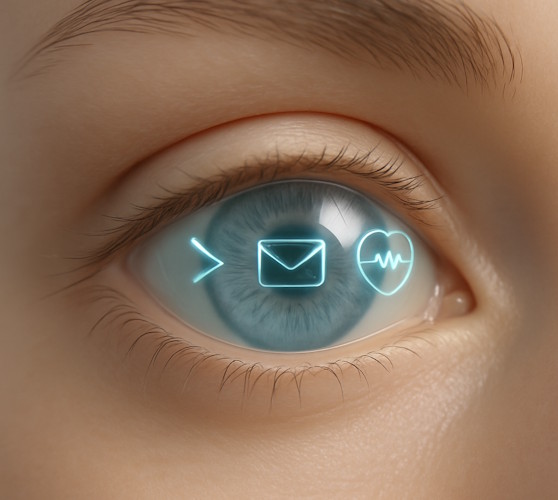
AR Smart Contact Lenses — concept art of a heads-up display you wear on your eye.
AR Smart Contact Lenses — ultra-thin, biocompatible lenses with embedded micro-displays and sensors that promise a discreet, always-available augmented reality experience without bulky glasses or headsets.
History
The idea dates back to early 2010s research combining micro-electronics with soft contacts. Universities and startups have since shown lab demos (simple pixels, sensors, wireless power). The long-term goal: a true on-eye HUD that looks like a normal lens.
What Makes It Special
A display that rides directly on the eye would enable crisp, private overlays with perfect alignment to your gaze. Tiny batteries or wireless power, eye-tracking, and low-power microLEDs could deliver notifications, turn-by-turn cues, captions, sports stats, and accessibility features—without announcing to the world that you’re wearing a device.
Cultural Impact & Legacy
From sci-fi (contact-HUDs in film/TV) to concept art, the “invisible AR” lens is a recurring dream. It fuels debates about etiquette, privacy, and the line between medical wearables and everyday computing—much like smart glasses did, only subtler.
Variants & Modern Versions
Likely paths include: (1) medical/assistive versions (low-vision aids, glucose sensing), (2) sports/industrial HUDs with limited overlays, and (3) consumer AR with notifications, navigation, and translation. Expect early versions to be monochrome or low-resolution before richer color.
Quick Facts
- Debut: Early research in the 2010s; ongoing prototypes
- Main Manufacturer(s): University labs & AR startups
- Materials: Biocompatible polymers, microLED/µdisplay, microsensors, ultrathin antenna/power
- Sizes: Standard soft-lens diameters; ultra-thin stack
- Notable features: On-eye HUD, gaze alignment, potential health/assistive applications
🧾 Availability & Price (as of August 2025)
Not commercially available. Strict safety, comfort, and power constraints mean consumer releases—if they happen—will likely start in limited use-cases (sports/medical) before mainstream.
Pricing (typical ranges)
- Common/loose: N/A (no retail)
- Special editions: N/A
- Rare/collectible: N/A
Where to follow progress
- Company blogs & AR startups
- Academic papers and wearable tech conferences
- Regulatory filings for clinical/field trials
Note: If/when products arrive, value will hinge on safety certifications, comfort, display quality, and battery/wear time.
Collector’s Corner
For concept and prototype collectors: verify provenance, version numbers, and demo capabilities. Store in cool, dry conditions; avoid magnetics/strong fields around micro-components; document any lab paperwork for authenticity.
Notable Records & Achievements
Early prototypes have demonstrated on-lens pixels/symbols, wireless telemetry, and sensor integration—stepping stones toward a practical on-eye AR HUD.
Fun Facts
- Invisible UI: No frames or temples—just a normal-looking lens.
- Power puzzle: Wireless power or ultra-tiny batteries are key constraints.
- Blink & you’ll miss it: Eye blinks and saccades demand clever display timing.