
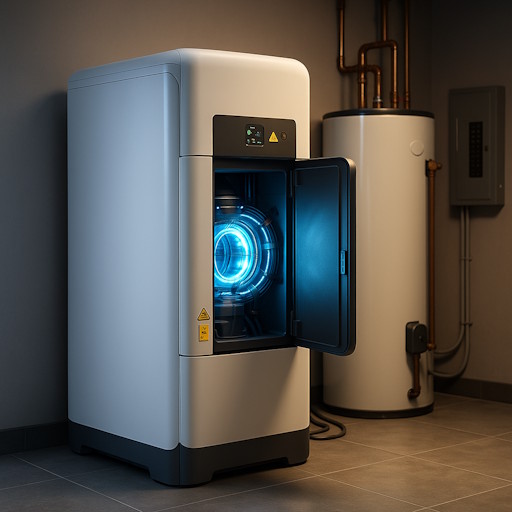
Fusion Micro-Reactors for Homes — a compact, clean-energy dream for on-site power.
Fusion Micro-Reactors for Homes — speculative, closet-sized power units that would fuse light atoms to generate steady, carbon-free electricity and heat for a single household or small building.
History
Fusion research dates to the mid-20th century with large tokamaks and laser systems. The 2020s revived interest in compact approaches (high-temperature superconducting magnets, magnetized-target and field-reversed configurations, advanced fuels) and “micro-reactor” ideas. A true home-scale fusion device remains conceptual, but neighborhood-scale units are often discussed as a stepping stone.
What Makes It Special
Near-zero on-site emissions, abundant fuel, and steady output independent of weather. A residential fusion unit could deliver baseload electricity plus hot water/space heat, with far higher energy density than batteries or fuel tanks. In aneutronic concepts, the primary by-product could be helium, potentially reducing long-lived waste.
Cultural Impact & Legacy
The promise of “power independence” reshapes how homes, neighborhoods, and remote sites think about energy, resilience, and grids. It also raises big questions: safety, siting, licensing, and how to balance private generation with public infrastructure.
Variants & Modern Versions
Paths often floated include: (1) Neighborhood-scale compact fusion feeding multiple homes; (2) Home-scale thermal units that drive solid-state converters; (3) Aneutronic fuels (e.g., p-B11) to minimize neutron shielding; (4) Hybrid systems pairing fusion heat with heat pumps and home batteries for peak loads.
Quick Facts
- Debut: Mid-century fusion research; “home” micro-reactor concepts popularized in the 2010s–2020s
- Main Manufacturer(s): Research labs & fusion startups (concept stage)
- Materials: Vacuum vessel, superconducting coils or pulsed-field drivers, shielding, power electronics, heat exchangers
- Sizes: Hypothetical appliance/closet scale for a single home; larger for neighborhood units
- Notable features: Carbon-free baseload, high energy density, potential cogeneration of heat
🧾 Availability & Price (as of August 2025)
No residential fusion products exist. Most activity is lab-scale or pilot planning for larger systems. If home-scale ever arrives, adoption will hinge on safety certification, shielding, maintenance, fuel handling, and local regulations.
Pricing (typical ranges)
- Common/loose: N/A (concept)
- Special editions: N/A
- Rare/collectible: Prototype components and demo hardware only
Where to follow progress
- Fusion startups & research consortia updates
- Regulatory/standards discussions on advanced nuclear & distributed energy
- Energy-tech conferences and pilot project announcements
Note: Even with aneutronic designs, shielding, fail-safe controls, and lifecycle servicing are major hurdles for any home-installed reactor.
Collector’s Corner
For concept collectors: seek authenticated design studies, engineering mockups, HTS tape samples, and signed white papers. Store components dry, away from magnetic fields and mechanical stress; retain provenance documents.
Notable Records & Achievements
Key milestones include higher-field compact magnets, improved confinement schemes, and demonstrations of self-healing or radiation-tolerant materials—building blocks toward any eventual small-scale fusion.
Fun Facts
- Aneutronic allure: Proton-boron concepts aim for fewer neutrons and simpler shielding—still very hard to realize.
- Heat is king: Most designs would first make heat, then convert it to electricity via turbines or solid-state converters.
- Grid buddy: Even “home” fusion would likely interact with the grid for backup, export, and safety monitoring.