
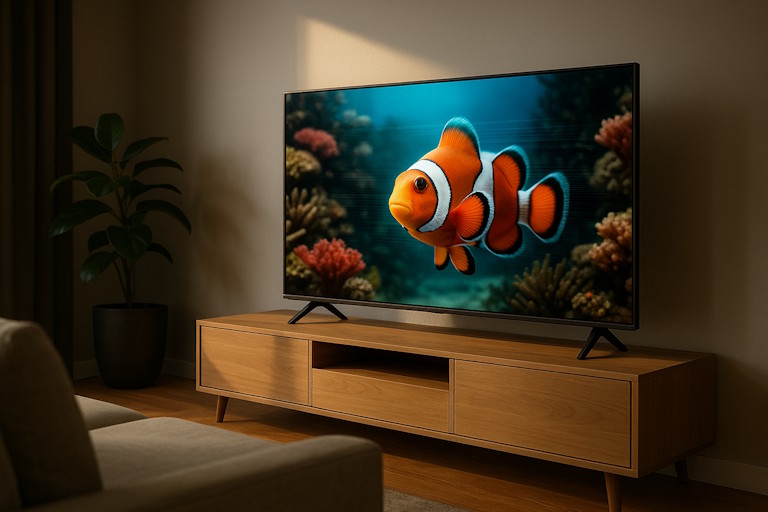
Light-Field Holographic TV — glasses-free depth and motion parallax for everyone on the couch.
Light-Field Holographic TV (Glasses-Free 3D) — a next-gen display that emits many angled rays per pixel so each viewer’s eyes receive slightly different images. The result: natural depth, motion parallax, and 3D you can lean into — no glasses required.
History
3D TVs with active/passive glasses peaked in the early 2010s, but comfort and content issues slowed adoption. Autostereoscopic prototypes (lenticular/barrier screens) showed glasses-free 3D, yet with narrow “sweet spots.” Light-field approaches push further by combining dense directional pixels, micro-lens arrays, and eye-tracking to support multiple viewers across a sofa.
What Makes It Special
True depth cues without headgear: binocular disparity, motion parallax, and focus cues can be simulated simultaneously. A light-field TV can show different angles to different seats, preserve 2D compatibility, and enable “mini-volumetric” effects like objects peeking behind others as you lean.
Cultural Impact & Legacy
Sports replays with lifelike depth, classroom models you can explore from multiple angles, and telepresence that feels more “there.” It blurs cinema, gaming, and AR — all on a living-room screen — while raising new challenges for production pipelines and accessibility.
Variants & Modern Versions
Approaches include micro-lens arrays over microLED/OLED panels, multi-layer LCD “directional backlights,” tiled light-field walls, and projector-based systems with eye-tracked rendering. Expect early wins in signage/museums before living-room TVs.
Quick Facts
- Debut: Lab demos in the 2010s–2020s; early commercial signage pilots
- Main Manufacturer(s): Display suppliers & startups (R&D)
- Materials: MicroLED/OLED emitters, micro-lens arrays, high-speed controllers, eye-tracking sensors
- Sizes: Tileable panels from desktop to wall-scale
- Notable features: Glasses-free 3D, multi-viewer support, motion parallax, 2D compatibility
🧾 Availability & Price (as of August 2025)
Consumer models aren’t mainstream. Expect early deployments in pro displays, theme parks, and retail. Costs hinge on directional pixel density, brightness, and compute for multi-view rendering.
Pricing (typical ranges)
- Common/loose: N/A (concept for home TVs)
- Special editions: N/A
- Rare/collectible: Prototype panels, lens sheets, dev kits
Where to follow progress
- Display trade shows & research labs
- Graphics/visualization conferences (light-field & volumetric capture)
- Pro AV and museum exhibit vendors
Note: Key hurdles are brightness, resolution per view, eye-box size, and easy content tools for creators.
Collector’s Corner
For prototypes: obtain lens array specs (pitch, focal length), panel resolution/refresh, and supported view count. Avoid heat/UV on lens sheets; store with dust covers to prevent scattering haze.
Notable Records & Achievements
Milestones include multi-view 4K/8K panels, live light-field capture from camera arrays, and eye-tracked demos that expand the sweet spot for multiple viewers.
Fun Facts
- Pixels, multiplied: One “pixel” can emit dozens of angled sub-pixels.
- Lean to reveal: Objects can appear to hide/reveal as you move your head.
- 2D still works: Standard content displays normally with the light-field off.