
Opens Amazon in a new tab
Newton’s Cradle on Amazon
Tap image to view on Amazon
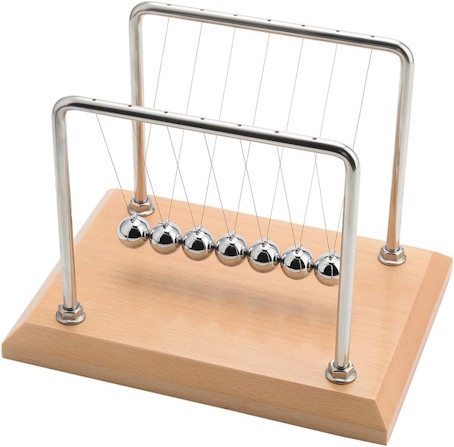
The Newton’s Cradle, first released in 1967 and popularized in the 1970s, is a timeless desk toy and educational tool. It visually demonstrates the principles of conservation of momentum and conservation of energy through a mesmerizing set of swinging spheres.
History & Origin
Although inspired by the work of Sir Isaac Newton, the modern version was popularized by actor and inventor Simon Prebble. It was first marketed as a novelty desktop accessory, quickly finding its way into offices, classrooms, and science museums worldwide.
How It Works
A Newton’s Cradle consists of identically sized metal balls suspended in a straight line. When one ball at the end is lifted and released, it strikes the next ball, transmitting its energy and momentum through the line so that the ball at the opposite end swings upward. This visual chain reaction continues until friction and air resistance slow the motion.
Cultural Impact & Legacy
Newton’s Cradles became symbols of intellect, calm focus, and the corporate office aesthetic. They’ve appeared in countless films, TV shows, and advertisements, often on the desks of characters meant to seem analytical or powerful. Large-scale versions have been built for science demonstrations and viral internet videos.
Variants & Successors
Models range from small, inexpensive plastic toys to precision-engineered, museum-quality pieces. Novelty versions use materials like glass, wood, or acrylic frames, while giant demonstration models can use bowling balls or larger spheres to show the principle on a dramatic scale.
Quick Facts
- Released: 1967 (popularized in the 1970s)
- Inventor: Inspired by Sir Isaac Newton; modern form by Simon Prebble
- Type: Desktop physics toy
- Materials: Steel balls, nylon strings, metal or wooden frame
- Size: Desktop versions typically ~6″ × 6″
🧾 Availability & Price (as of August 2025)
Newton’s Cradles are widely available both as affordable novelties and as premium decorative or educational models. They can be found at office supply stores, gift shops, science museums, and a variety of online retailers.
Pricing (typical ranges)
- Common desk versions: $10–$40 USD
- Premium models: $50–$150 USD
- Mini novelty versions: As low as $5 USD
- Large demonstration models: $200+ USD depending on materials and craftsmanship
Popular places to buy
Note: Prices reflect typical listings as of August 2025. Availability and pricing may vary by region, condition, and seller.
Collector’s Corner
Collectors often look for high-quality construction with perfectly aligned balls, minimal frame wear, and strong, untangled strings. Vintage models, especially those with original packaging, branding, or unique designs, can command higher prices. Beware of low-cost replicas with poor build quality if purchasing for long-term display or demonstration.
Notable Records & Achievements
Some of the largest Newton’s Cradles ever built include a 15-bowling-ball version created by The Geek Group and oversized installations in science centers. The concept has been tested on shows like MythBusters, using wrecking balls to explore the physics at a massive scale.
Fun Facts
- Not Newton’s Invention: While named after him, Newton didn’t invent the device — it simply illustrates his Third Law of Motion.
- Pop Culture Icon: Featured on the desks of superheroes, scientists, and corporate villains in countless films and TV shows.
- Supersized Physics: The Geek Group once built a giant version using 15 bowling balls suspended three feet high, demonstrating momentum transfer on a dramatic scale.
- MythBusters: Attempted massive wrecking-ball versions, revealing both the potential and limitations of scaling up the concept.
Watch: The Physics of Newton’s Cradle
Video courtesy of Discovery on YouTube.