

Opens Amazon in a new tab
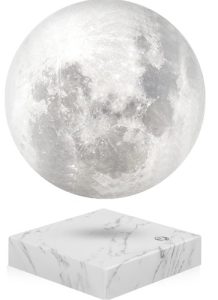
A floating, slowly rotating moon—powered by hidden magnets and wireless induction.
Click Image to view on Amazon in a new tab
Levitating Moon Lamp — a 3D-printed lunar globe that floats above its base using magnetic levitation and glows with warm or RGB lighting. It’s part science demo, part art piece, and 100% conversation starter.
History
Levitating display tech has been around for decades, but it became accessible for home décor in the 2010s as small magnet arrays, position sensors, and induction coils got cheaper. Moon lamps took off as makers combined detailed lunar surface models with mag-lev bases, creating a night-light that looks straight out of sci-fi.
What Makes It Special
The lamp actually floats. A feedback loop in the base stabilizes a magnetic field that suspends the moon several millimeters above the surface. Wireless power (induction) feeds LEDs inside the globe, so there are no wires connecting the two—just a hovering, gently spinning moon.
Cultural Impact & Legacy
From dorms and home offices to boutique lobbies, the levitating moon became a social-media-friendly desk icon—equal parts cozy light and science trick. It helped popularize premium “tech-art” décor alongside ferrofluid displays and kinetic desk sculptures.
Variants & Modern Versions
Sizes typically range from mini orbs to larger 6–8–10″ globes. Bases vary from wood to matte black metal; some offer touch dimming, color-temperature presets, RGB cycling, or app control. Planet variants (Earth, Jupiter, Saturn) and textured “crater” finishes are common.
Quick Facts
- Debut: Became mainstream in the mid-to-late 2010s
- Main Manufacturer(s): Multiple boutique and OEM brands
- Materials: 3D-printed PLA/ABS moon shell, LED module, magnet & sensor array, wood/metal base
- Sizes: Commonly ~6–10″ globes; compact minis exist
- Notable features: Magnetic levitation, wireless power, touch/app dimming, slow rotation

Opens Amazon in a new tab
This concept works well for a floating, slowly rotating Earth globe too.
Click image to view on Amazon
🧾 Availability & Price (as of August 2025)
Widely available online from multiple brands and makers. Pricing depends on globe size, base materials, lighting features, and overall build quality.
Pricing (typical ranges)
- Common/compact models: ~$70–$150
- Mid-range (larger globe, nicer base, RGB/app): ~$150–$300
- Premium/artist editions: ~$300–$600+
Popular places to buy
Note: Expect a short “learning curve” to find the levitation sweet spot. Quality models re-lock quickly and stay stable with a faint hum or none at all.
Collector’s Corner
Check for stable float (no frequent drops), quiet operation, and even LED color/brightness. Inspect the moon’s seam line and surface detail; sharper craters usually indicate a higher-quality print. Verify the power adapter specs match the base. To preserve, avoid heat, dust the base sensor area, and keep magnets away from credit cards and hard drives.
Notable Records & Achievements
A breakout example of consumer magnetic-levitation décor—turning lab-grade tech into an everyday ambient light and gift item.
Fun Facts
- No wires across the gap: Power is sent wirelessly from the base to the moon’s LEDs via induction.
- Spins from air currents: Many units rotate slowly because of tiny air movements and the globe’s weight balance.
- Alignment magnets: Some models include a small helper magnet tool to find the “lock” point over the base.
Watch: How to set up floating moon lamp
Video courtesy of @besthomeplanetarium on YouTube.