
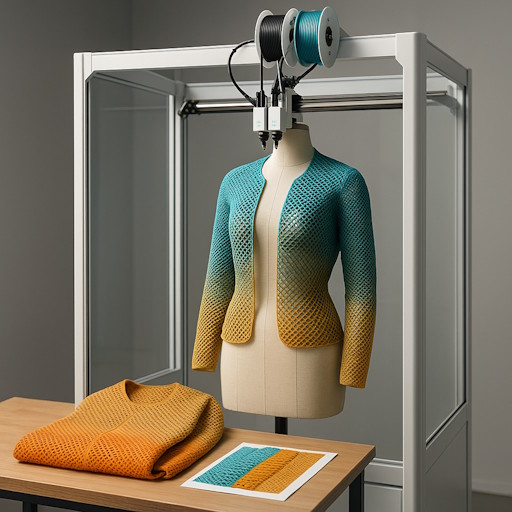
On-Demand 3D-Printed Clothing — scan, select, and print a custom-fit garment without traditional sewing.
On-Demand 3D-Printed Clothing — fashion made like software: you pick a design, scan your fit, and a printer lays down flexible polymers or fiber-reinforced filaments to form a garment that’s made-to-measure in hours, not weeks.
History
Early 2010s runway experiments proved 3D-printed dresses could exist, but comfort and durability lagged. As printers, slicers, and flexible materials improved (TPU/TPE blends, knit-like lattices), designers began prototyping wearable, washable pieces and modular parts you can reprint or resize.
What Makes It Special
Zero inventory and zero pattern waste, with scan-to-fit sizing, parametric styles (length, taper, texture), and the ability to patch or reprint worn sections. Designs can integrate stretch zones, ventilation patterns, and fasteners directly in the print—no cutting or sewing required.
Cultural Impact & Legacy
Mass customization meets sustainability. Boutique “print bars,” makerspaces, and at-home units could shift clothing from mass production to local manufacturing. It also sparks new questions about digital fashion IP, resale of print files, and standards for recyclable feedstocks.
Variants & Modern Versions
Home printers that handle accessories and simple garments; in-store kiosks for custom tees, leggings, and footwear uppers; service bureaus that print haute-couture lattices; hybrid processes that print onto fabric backings for comfort and breathability.
Quick Facts
- Debut: Runway prototypes in the 2010s; maker/community pilots in the 2020s
- Main Manufacturer(s): Fashion-tech startups, printer OEMs, materials companies
- Materials: TPU/TPE, recycled PETG blends, bio-based polymers, fiber-reinforced elastomers
- Sizes: Accessories to full garments; multi-panel prints for larger pieces
- Notable features: Scan-to-fit sizing, parametric style controls, modular repair/upgrade parts
🧾 Availability & Price (as of August 2025)
Consumer-ready systems are emerging as pilots and boutique services; mainstream home printing of full outfits is still early. Costs depend on print time, material, and finishing; expect initial offerings via studios and kiosks before at-home becomes common.
Pricing (typical ranges)
- Common/loose: N/A (concept for full-garment home printing)
- Special editions: N/A
- Rare/collectible: Prototype garments, signed design files
Where to follow progress
- Fashion-tech labs & maker communities
- 3D-printing materials and hardware conferences
- Design marketplaces for parametric garment files
Note: Comfort, wash/wear durability, print speed, and easy recycling of worn parts will decide when this goes mainstream.
Collector’s Corner
Archive both the physical garment and the digital design (file version, slicer profile, material batch). Store away from heat/UV; keep spare filament/pellets dry. Document fit scans to reproduce the original look later.
Notable Records & Achievements
Milestones include seamless lattice garments, multi-material prints for built-in stretch, and print-on-fabric techniques that survive machine washing while keeping shape.
Fun Facts
- Patch, don’t toss: You can reprint elbows or knees instead of replacing the whole item.
- Parametric closets: One file, endless variants—lengthen hems, tighten waists, change textures.
- Color on the fly: Mid-print filament swaps can create stripes or gradients without dye baths.