
Quantum-Secure Phone — a handset designed to resist future quantum attacks on today’s encryption.
Quantum-Secure Phone — a next-gen smartphone concept that bakes in post-quantum cryptography (PQC), hardware-level key protection, and optional quantum features (like true random number generation) to safeguard calls, messages, and data against “harvest-now, decrypt-later” threats.
History
For decades, phones have relied on public-key cryptography that powerful future quantum computers could break. As research matured, security standards bodies began selecting and standardizing PQC algorithms designed to withstand quantum attacks. Prototype “secure phones” appeared in enterprise and government niches, but a mass-market, quantum-resilient handset remains a forward-looking idea.
What Makes It Special
It combines multiple defenses: post-quantum algorithms for messaging and key exchange; hybrid handshakes that mix classical + PQC during the transition; a secure enclave that stores keys in tamper-resistant silicon; a quantum-grade RNG for truly unpredictable keys; and end-to-end encrypted calling/messaging as the default.
Cultural Impact & Legacy
A quantum-secure phone could reset expectations for private communication—especially for journalists, healthcare, finance, and everyday users who want future-proof privacy. It also raises usability questions (key backups, migration) and pushes carriers, clouds, and apps to adopt PQC end-to-end.
Variants & Modern Versions
Potential flavors include: (1) PQC-only consumer phones with hybrid handshakes for compatibility; (2) Enterprise hardened phones with locked boot, audited firmware, and physical kill-switches; (3) Satellite/mesh options for resilient, encrypted links; (4) Accessorized QKD pilots in specialized networks (long-term possibility, not consumer-ready).
Quick Facts
- Debut: Concept matured in the 2020s alongside PQC standardization
- Main Manufacturer(s): Security-focused OEMs & chipset vendors (concept/R&D)
- Materials: Standard handset stack + secure enclave, hardware TRNG/QRNG, shielded antennas
- Sizes: Typical smartphone form factors
- Notable features: PQC messaging/calls, hybrid key exchange, hardware key vault, secure boot, encrypted backups
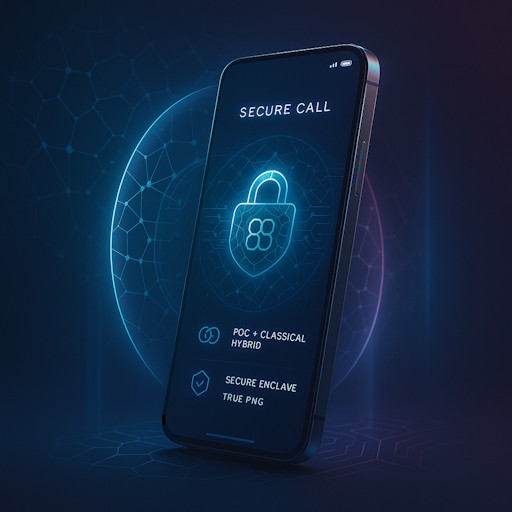
Quantum-Secure Phone — a handset designed to resist future quantum attacks on today’s encryption.
🧾 Availability & Price (as of August 2025)
No mainstream retail phones advertise full quantum-secure stacks yet. Expect early adoption in enterprise/government devices and secure apps, followed by consumer models as standards finalize across carriers and major platforms.
Pricing (typical ranges)
- Common/loose: N/A (concept)
- Special editions: N/A
- Rare/collectible: Prototype hardware, dev kits, signed security modules
Where to follow progress
- Security standards bodies and open-source crypto libraries
- Chipset vendors (secure enclave/TRNG roadmaps)
- Encrypted messaging and secure OS projects
Note: Real-world protection depends on end-to-end adoption (apps + OS + servers), safe key backups, and careful rollout of hybrid cryptography during the transition period.
Collector’s Corner
For prototypes: archive firmware hashes, bootloader state, enclave model, and algorithm versions. Store with tamper-evident seals; keep documentation of threat models and security audits for provenance.
Notable Records & Achievements
Key milestones include shipping PQC in major libraries, secure enclave support for larger keys, and hybrid handshakes deployed at scale—building blocks for any future quantum-resilient phone.
Fun Facts
- Harvest-now risk: Attackers can record encrypted traffic today and try to decrypt it in a post-quantum future.
- New math: Many PQC schemes rely on hard lattice problems instead of today’s factoring/elliptic-curve math.
- Hybrid era: Devices may use classical + PQC together for years to smooth the transition.